

Two Ears, One Mouth
We are so used to calls to speak our truth and demands for the right to be heard we forget that means someone has to actually listen.

When things got a little raucous in his classroom, one of my school teachers would shout a reminder:
“You’ve got two ears and one mouth. Listen!”
I don’t know if he knew it, but he was quoting the Stoic philosopher Epictetus, a slave born in first-century Rome, who put it slightly more elegantly:
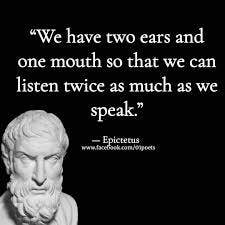
The quote has always stuck with me, rattling around my head in a time where we champion speaking our truth and our right to be heard. Don’t get me wrong, it’s a good thing that many who never had a voice are speaking up, but only if we remember there is another half to the equation:
If we want to be heard: someone has to be listening.
Now, more than ever, we need to sharpen our listening skills. This is not just another cry for empathy, though we certainly need it. It can be a hard-nosed strategy to improve our lives - helping us realise when we are getting things wrong.
And as I will go on to explain - it saddens me to know my father’s failure to realise this cost him dear
The most obvious place to see the failure to listen is almost any major election campaign, such as the one the UK been through in the last few weeks. The Labour party swept to power just two years ago with one of the largest majorities in modern history. This week, voters delivered a brutal verdict: over a 1000 council seats lost, populism surging across the country, and yet another Prime Minister facing open questions about his future.

You can read that result in many ways, but the simplest is this: millions of people still do not feel heard. It’s easy to list the areas that worry them (not least the cost of living and immigration) but if we listen, really hear what is being said, there is something deeper: people want the enormous leadership vacuum to be filled. Those who voted for populists often said it wasn’t about the policies, it was rolling the dice, thinking: “Maybe these people will get it. Maybe these people will have a plan.”
The overwhelming lesson I took from my six years as the Director of Politics and Communications in No. 10 Downing Street is:
You can’t make your case until it is clear you have listened; you can’t make a rational argument before you have made an emotional connection.
The failure to live that has resulted in a group of parties in constant broadcast mode, hoping their soundbites and platitudes will be mistaken for a serious plan - and when they are found out in power, surprise that the electorate slaps them.
The failure to listen isn’t just an crisis in the political sphere. It applies to our day-to-day lives too.
We cannot engage with another person on anything that matters if we have not first understood what they think and feel and why they think and feel it. Ironically, I find this easy to say and hard to do. Too often I realise I am waiting for someone to finish so I can deliver my point. And when that happens, it’s usually a recipe for misunderstanding on both sides.
Simone Weil, the French philosopher, put it beautifully:
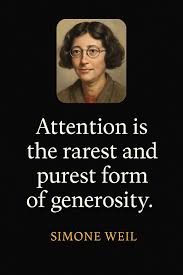
And she was right: there is generosity to the person we are listening to, but also to ourselves, because so often we can actually achieve what we want and need by tuning in:
What are the points, arguments, myths, and misunderstandings I need to have heard and engaged with in order to be effective.
That’s a hard-nosed reason to listen - the chance to ensure we get things right.
At an extreme, it can be weaponsied. Many times I have seen how a studied silence allows another person to reveal more than they perhaps should: the interrogator who realises saying nothing lets the subject fill the space; the negotiator who asks one question and then waits. On these occasions, listening is not passive. In the right hands, it is one of the most powerful tools there is, recognising there is something to be gained from not being set to transmit.
Is there a contradiction here? Is it cynical to listen with intent? I don’t think so. The best listening allows us to consider when we need to adjust, or even - most importantly - to realise when we our plan won’t work.
The same schoolteacher who told me about two ears and one mouth also told me something else: you can understand a great deal about another person by the language they use. What similes and metaphors do they reach for? Is there clarity in their thinking, or is what they are saying a jumble of half-truths, assertions, and clichés? You can only hear these things if you are genuinely paying attention. Most of us are too busy preparing our reply.
I have spent a lot of my professional life thinking about interviews. At the BBC, and then at Number 10, where a great deal of my time was spent preparing the Prime Minister for them. And what I learned preparing people for both sides of the microphone is counterintuitive. The easiest interviews to handle were the most aggressive and pre-prepared. The interviewer would come at us hard, and we would defend and pivot, duck and dive.
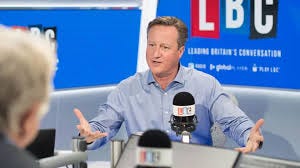
The far harder interviews were the ones where picked up on something that was being said - asked for clarity. They pointed out the weakness in what had actually been said and left space for us to struggle to deal with it. The interviewer who listens and responds, rather than reacts, is far more dangerous than the one who attacks. If you are insistent on a relentless point, you miss the gap and the weakness.
I think of my father. He was a Chief Constable in Scotland, a man of strong convictions and real ability - but with fixed views and an intolerance of those who disagreed. He became convinced about hardline drugs policies (I was never a fan, but that’s another story). He set his heart on persuading Tony Blair’s government that the UK needed a “Drugs Tsar” to coordinate policy. They became convinced of the need for the role - but George Robertson, the cabinet minister tasked with delivering it, disappointed my father, not giving him the job, telling him, “You’ve made too many enemies.” He was denied because he hadn’t listened effectively and then engaged enough in his career - and those people made him pay a price. I find myself deeply saddened as I write this - thinking of him blocked and stymied because he hadn’t learned to listen and engage.
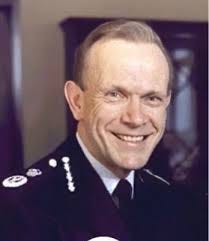
I suspect most of us can think of someone like my father. Perhaps, in honest moments, we can see when we have failed because we have failed to listen.
In To Kill a Mockingbird, Atticus Finch tells Scout:
“You never really understand a person until you consider things from his point of view… until you climb into his skin and walk around in it.”
The entire moral architecture of that novel rests on one man’s willingness to listen to people that everyone else has already judged or ignored.
Anyone who reads this Substack knows I am not short of opinions. But the hardest thing I have tried to do is to set them aside and listen. To really hear what someone is saying, rather than filtering it through what I already think. It’s a work in progress, but when I manage it, I am so much clearer about how to approach life. When I don’t, I make the same mistakes my father made: seeing certainty for wisdom, and volume for persuasion.
Listening is not weakness. It is not passivity. It is the mechanism by which we come to understand - and that is of immense value.
Perhaps, when we look back on this time, we will see it as a noisy period in which we temporarily forgot the value of deep listening, and what Epictetus told us two thousand years ago:
We have two ears and one mouth so we can listen twice as much as we speak.
(If you have found this Substack useful, please hit the heart-shaped ‘Like’ button or the circular ‘Restack’ button - it helps more people see it. Thank you.)
I’m not sure you could write as beautifully as this if you hadn’t learned to listen and pay attention yourself Craig. Great piece